Category Archives: Uncategorized

A beautiful solution?

On 4 February, the Rt Hon John Hayes MP, Minister of State for Transport, gave a speech titled ‘Beautiful roads’ at an event hosted by Campaign to Protect Rural England (CPRE) and Campaign for Better Transport (CBT).  It contains this promising phrase:

“Our goal is not just to undo the most intrusive, insensitive road design of the past 50 years….”

If he means what he says, the Crossbush junction on the A27 at Arundel is a prime candidate for demolishing and rebuilding.  I suggest that the Crossbush junction – and the Crossbush bypass – are good examples of “the most intrusive, insensitive road design of the past 50 years”.

The Crossbush junction is half of an uncompleted ‘dumbbell’ junction.  It is known locally as ‘the diving board’ since it raises the A27 (going westwards) and then stops, turning into a T-junction with lights, with both arms of the T becoming a single carriageway road, one going down to Arundel.  The intended A27 dual carriageway is an unused strip of tarmac which ends in a bank under the junction.

The Crossbush bypass should really have been treated as part of the (unbuilt) Arundel bypass which it would adjoin.  In other words, it should not have been built unless and until an acceptable route for a bypass at Arundel was found.   But the Crossbush bypass was built in the 90s, and stands as a monument to human folly – ‘expecting’, or encouraging, a completion with an Arundel bypass which cannot be built because it is too environmentally damaging.

Two offline bypass alternatives at Arundel were suggested by the recent A27 Study.  All offline routes would cross the Arundel watermeadows, then bisect Tortington village, south of Arundel. One, the previous Preferred Route, then goes through much-loved and nationally protected woodland (Tortington Common, part of the South Downs National Park), the other through the villages of Binsted and Walberton.  Neither road would be beautiful.  Instead both would be terribly destructive.

The Crossbush junction stands at the eastern side of the Arun valley, a floodplain with small fields and hedges, described by a previous Secretary of State, Alistair Darling, as of ‘outstanding beauty’ when he cancelled the Arundel bypass in 2003 (the Preferred Route through Tortington Common).  Even as it is, without the Arundel bypass, the junction is looming, high, ugly, inappropriate, and has brought the inevitable large service station and fast food outlet, themselves a blot on their beautiful surroundings.

The best way to improve the ugliness of the junction would be to demolish it and replace it with an at-grade  roundabout, accepting that a dual carriageway across the Arun valley watermeadows, through Tortington, and then through either the National Park woods or two more villages, is not appropriate or possible and could not be ‘beautiful’.  Such a plan would represent a commitment to protecting what is truly beautiful.  The looming ‘diving-board’ would disappear and the monument to human folly would become a story of the attainment of wisdom.

Many local people do not want increased capacity on this road, leading to more traffic and further traffic jams, but would accept smaller-scale work to improve traffic flow.  Some improvement of the A27, at a less intrusive scale, nearer to its current route, is possible without being as destructive as a completely offline bypass, and should be one of the options in the coming public consultation.  The Crossbush bypass cannot be unbuilt, and the least damaging solution would be to join the A27 at Crossbush to the current Arundel bypass with a short section of new, non-dual-carriageway road passing south of Arundel station.  This could be combined with the changes to the junction suggested above.

Let’s hope the Minister’s commitment to ‘undoing intrusive, insensitive road design’ will be strong enough to encompass this proposal.

Emma Tristram, resident of Binsted

Better Buses not Bigger Roads

Norman Baker MP stops to join members of SCATE outside Eastbourne Town Hall

Norman Baker MP stops to join members of SCATE outside Eastbourne Town Hall – photo Kim Sweet

That’s the message that members of SCATE took to Eastbourne Town Hall yesterday on a wet and windy morning.  They were protesting at being excluded from a meeting organised by the Department of Transport (DfT) to talk about the A27 and growth.  In attendance were local MPs, councillors and businesses.

The reason given for excluding community and environmental organisations was that this was a meeting with representatives of various levels of government rather than with wider sectorial interests.  Yet the DfT invited the Local Enterprise Partnerships (unaccountable quangos not subject directly to the Freedom of Information Act) and local businesses.

But maybe this shouldn’t be surprising.  Government seems to be handing over the running of the country to big business, removing or watering down legislation (e.g. planning) at its request, while stifling democratic debate via the Gagging Act, preventing charities from challenging (or welcoming) political statements by parties.  At the same time when Cuadrilla writes to George Osborne to ask for action to make fracking easier, you’ve never seen the Government move so fast.

Back in East Sussex, we’ve seen sprawling car based development and more road building.  At the same time that more money has to be found to keep the Bexhill to Hastings Link Road going, there are swingeing cuts and prices rises to local bus services despite huge protests. Meanwhile there is very little investment in walking and cycling or the south coast rail line which runs parallel to the A27 and could offer more of an alternative to driving if properly invested in.

By our exclusion, the DfT is likely to back more expensive and inefficient growth, fuelling congestion and pollution across East Sussex.  Sprawling development will waste land, swallowing up more of our precious countryside and because of its low density any bus services serving these developments are likely to require subsidy.

Derrick Coffee of Campaign for Better Transport - East Sussex button-holes Secretary of State for Transport, Patrick McLoughlin MP in Eastbourne

Derrick Coffee of Campaign for Better Transport – East Sussex button-holes Secretary of State for Transport, Patrick McLoughlin MP in Eastbourne – photo Kim Sweet

It is clear from the evidence to date, that our elected officials are not able to plan in the true sense of the word.  Some of that is not their fault with the weakening of the planning system by central Government.  Nevertheless, they are failing to plan for the long term and to prioritise people’s well-being over short-term gain.

We have an opportunity now to get it right.  To design our communities in a healthier and more robust way which improves people’s quality of life while reducing our impact on our environment.  We should not accept the premise that to improve our economy we have to destroy what we hold most dear.  There is another way.

Parishes reject major road building for A27

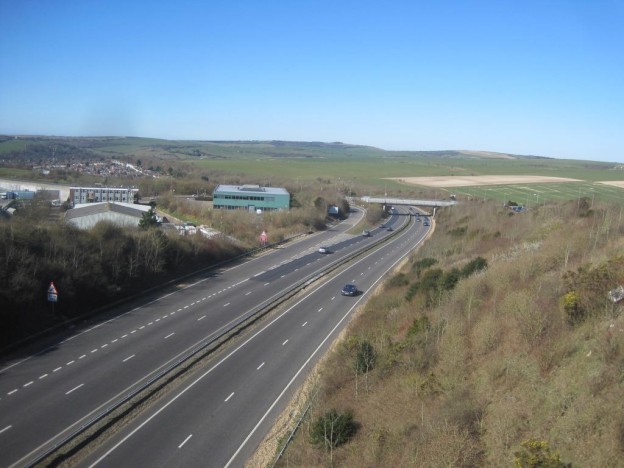
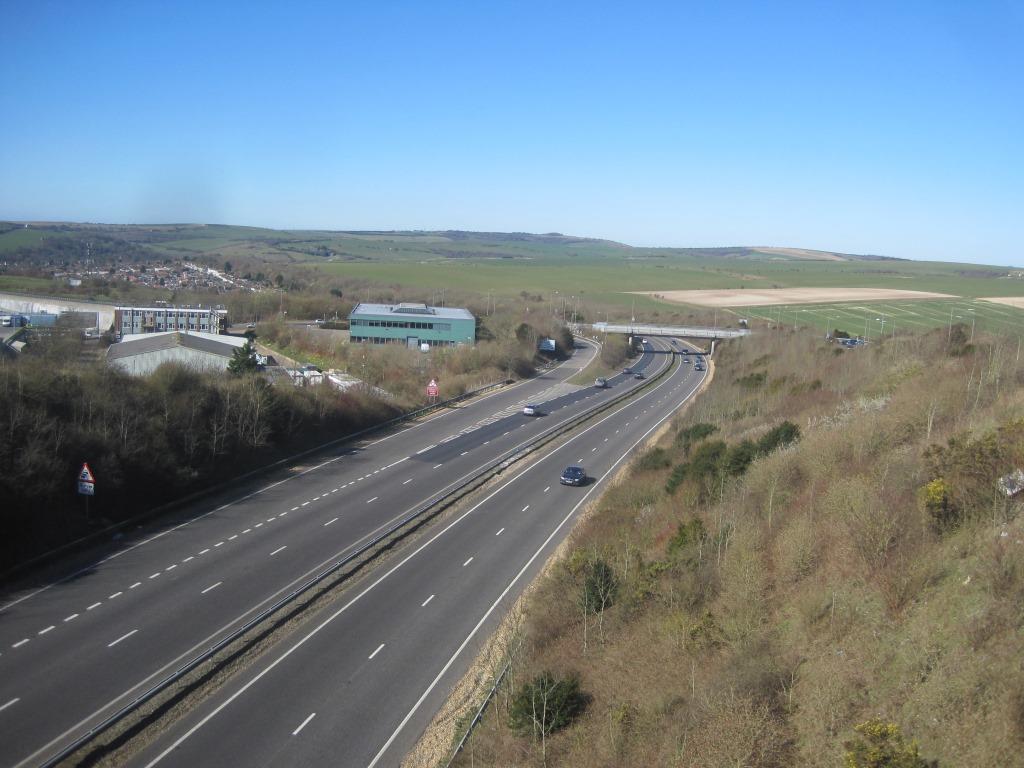
View of A27 from Mount Caburn

View of A27 from Mount Caburn

A recent meeting of Parish representatives from east of Lewes to Folkington has welcomed the £75 million nominally allocated by the Government for improvements to this section of the A27. However, the representatives have resoundingly rejected the idea of a major bypass or new road from Lewes to Polegate.  Instead they want to see the money used to improve road safety along the existing alignment, with improved local access at junctions, as soon as possible.  They want the focus to be on improving traffic flow, but not increasing traffic speed.

In particular, the meeting supported the following measures:

  1. Junction improvements all along the route, with improvements particularly needed at Wilmington and Selmeston
  2. A safer crossing between the Firle and Glynde junctions for pedestrians and cyclists
  3. A Selmeston bypass behind the Barley Mow
  4. A single speed limit along this stretch of road and related measures

In contrast, there was no support for the Folkington Link.

All of these measures would make a marked improvement to safety and access along the route and could be implemented quite quickly, in comparison to a major new road.  While a Selmeston bypass behind the Barley Mow would intrude into the South Downs National Park, this might be acceptable if done sensitively.

Overall, this approach by the Parishes seems sensible and pragmatic, and if implemented would lead to real improvements without causing the widespread damage and destruction of new road building.

On the rails in 2015

Let the train take the strain

Welcome to 2015 and higher rail fares, while oil prices fall to new low, resulting in even cheaper motoring.  No doubt that will lead to more pollution, congestion and associated health impacts, but that’s alright as long as motorists don’t pay for the many external costs they impose on society.

In addition, buses continue to be under attack from local authorities who see them as easy targets for cuts.  Even when East Sussex County Council votes not to cut bus services, it appears that its decision can be overruled by an elite cabinet, seemingly unaccountable to no one.

In the meantime we have a rail network straining at the seams with the large increases in rail travel over recent years.  Yet away from the main intercity routes, services and connections can be pretty poor and offer little choice to people who need or want to move around without a car.  That’s why three consultations might be of interest to people, some with pretty short deadlines so don’t delay if you want to have your voice heard:

  • Network Rail is currently consulting on its South East Route Sussex area route study.  This is currently rather London-centric and largely ignores other rail journeys. Email them at SussexRouteStudy@networkrail.co.uk to ask for the re-opening of the Uckfield – Lewes line.  Reasons here if you need them plus other ideas for improvements along the south coast, such as building the Willingdon chord and new stations.  All would help reduce traffic on A27 and other roads.  Feedback required by 13 January, so hurry!  See this blog for ideas of what to say
  • Govia Thameslink is nearing the end of a 12 week consultation on a new off-peak timetable from December 2015.  The Cooksbridge Station Partnership has contacted SCATE to ask for our support in pressing for more off-peak and weekend services.  There may be other areas we wish to see improvements too.  Email your comments to: gtr.timetableconsultation@gtrailway.com by Friday, 30 January
  • At the same time as all this is happening, Network Rail is holding a consultation on radical proposals which could drastically alter the way the railways are planned and run.  Improving Connectivity is a long-term proposal to deliver substantially improved rail connectivity across Britain. It requires a different approach to planning both the network capability and the train services which operate on it.  Deadline for comments is 31 January.  Email improvingconnectivity@networkrail.co.uk or complete their online survey.

Amusing take on the Government’s Roads Announcement

Today saw the Government announce that it is committed to building a mile of new dual carriageway through the Stonehenge World Heritage Site and dismiss the environmental impact of building in the South Downs National Park, destroying ancient woodland and harming the setting of Arundel.

Added to this the huge amount of money being spent on roads in a gamble to boost the economy is likely to fail.  Meanwhile the coastal railway is starved on any real investment and air pollution and congestion in our towns and cities is likely to rise.  Bus services are being cut and local authorities are struggling to provide much needed services as their budgets are slashed.

In the face of all this, take some time out for an amusing reworking of the Department of Transport’s press release.  Sometimes you just have to laugh.

Arundel residents want ‘smart’ spending of government funds for A27

As the government announces £350m for the A27 corridor, from Chichester to Polegate, Arundel residents say the money for Arundel should be spent on improvements along or near the existing route and include better access to public transport, cycling and walking, rather than be wasted on an ineffective and unaffordable bypass, seriously damaging the Arun Valley landscape and National Park.

The proposed ‘offline’ options for an Arundel bypass would mean a dual carriageway crossing the Arun Valley from Crossbush, over water meadows and either cutting through the ancient woodland at Tortington Common, close to the western edge of Arundel, the village of Tortington and Havenwood Park, or through the historic landscape and villages of Binsted and Walberton.

‘This would be a gross waste of money.’ said Sue White, Arundel resident and business woman. ‘We want smart, 21st century thinking for transport, not lumbering, outdated roads that we know will simply generate more traffic, increase local congestion and destroy town centres and small businesses, just as similar roads have done elsewhere.’

Philip Gadsby, retired engineer and Arundel resident pointed out that local people have been excluded from the discussions about options for transport and access along the Sussex coast and many people had no idea about plans until SCATE brought them to their attention. ‘We are now told we will be consulted, but the Department for Transport appears to have already narrowed our options to a bypass. There has been no debate locally on this controversial issue in over 20 years and ideas about transport and related issues have changed.’

He added, ‘the DfT study appears to have been unreasonably rushed and, contrary to modern transport thinking, it has focused only on road-building rather than addressing transport in an integrated way.’

Kay Wagland, resident of Ford Road, Arundel and chair of the Arundel SCATE group , said ‘The offline proposals are hugely damaging and just won’t help in the long term. They would destroy the countryside and wildlife that local people love and that attracts visitors to the area, adding noise and light pollution too. There are other options that would provide more choices for commuters, young people and the elderly, that would be less wasteful and damaging. Recent DfT reports have shown that money spent on improving local access, walking and cycling are not only healthier, but better value for money.’

The residents’ group, Arundel SCATE, was set up this year in response to the Department for Transport Feasibility Study which started a year ago, to inform local people about the plans and to provide a forum for discussion.

ENDS

Local transport is healthy and cost effective

A new University of the West of England study for Department for Transport was recently published which showed how investment in walking and cycling, offers better economic returns than road building.  The executive summary says: ‘Investment in infrastructure or behaviour change programmes which enable increased activity levels amongst local communities through cycling and walking is likely to provide low cost, high-value options providing benefits for our individual health. This improvement also has major benefits for the NHS in terms of cost savings, for the transport system as a whole, and for the economy through more efficient use of our transport networks.’

Road supporters take misleading campaign to Westminster

Using public money, the A27 Action (a front for local councils, MPs and some businesses) is promoting a controversial proposal for the A27 that was rejected 10 years ago for the harm it would cause the Arun Valley and the huge cost and damage that would result at Worthing.  It has used its members influence to get an audience with the Secretary of State for Transport hoping to influence the outcome of the current Department for Transport (DfT) A27 feasibility study.

A27 Action is misleading local business and residents, telling them that more roads will bring long term benefit despite the lack of evidence to support these claims. It is also telling the DfT that its proposals are supported by residents, when it is clear that there is considerable local concern over the nature of its proposals at Arundel and elsewhere and people have not been informed or consulted on this in over 20 years.

However, DfT has increasing evidence of local opposition to A27 Action plans and itself published a new report showing that investment in integrated public transport and improved access provides much better value for money than large scale road building.

It is hoped that the government will not succumb to what Steven Norris, a previous Conservative Transport Minister, described as ‘grand project-itis’, that it will ensure information provision and open public debate and not opt for a massively damaging and money-wasting schemes.

A27 at Hollingbury

Lack of transport vision could blight National Park

On Tuesday, the South Downs National Park Authority discussed its position statement on new transport infrastructure.  This has been drawn up in response to the potential expansion of the A27 but broadened out to include rail, ports and airports.

At the start of the meeting members were reminded that they were there to uphold National Park purposes, not any other interests that they might represent outside of the room.  They were then addressed by Dr Tony Whitbread, chief executive of Sussex Wildlife Trust, Chris Todd from Brighton & Hove Friends of the Earth and Campaign for Better Transport and by Kay Wagland, local Arundel resident and founder of Arundel SCATE.

A27 at Hollingbury

A27 at Hollingbury

All expressed their concern that expanding the A27 would have a large impact on the National Park.  This would not be localised to where changes were made but spread along the whole length of the South Downs and potentially lead to other expensive and damaging interventions.  Indeed, a key concern was that rather than solving congestion, an expanded A27 would create more traffic and ultimately more congestion, albeit in slightly different places.

The debate was interesting and highlighted that several members were struggling to leave their other responsibilities at the door.  However, the vast majority were sincere in their approach, even if they did occasionally say some rather contradictory things.

The Authority eventually agreed a much amended but largely improved position paper, although it did contain a few anomalies and leading statements – for example it specifically mentions the A27 and roads when it is meant to be a position statement for transport infrastructure.  The final statement while a useful and competent outline of the Authority’s position and the South Downs’ special qualities, is a rather dry document.  It contains no vision, nor does it really come across as championing the South Downs landscapes in a way that it could and perhaps should have done.  It also contained one serious omission in that it failed to mention, let alone address, the cumulative impact of expanding several sections of the A27.  This is a serious omission and weakness which is hampered by not having a strategic vision.

While an amendment to insert a vision into the document narrowly failed, members agreed that it would be good to take more time to develop one and that perhaps this could be developed through the Local Plan process.  We shall have to wait and see whether the Authority delivers on this, but in the meantime it will be interesting to see whether this new position statement will have any impact on the current A27 study process.

Second public meeting for Arundel

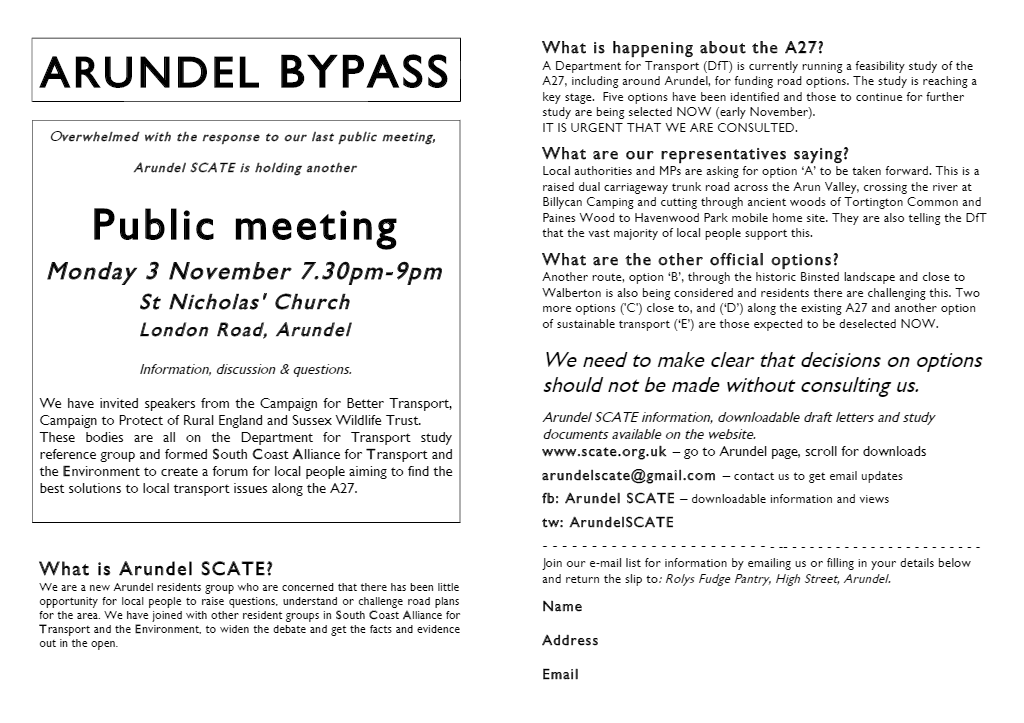
Due to the fact that so many people were unable to get into the meeting to discuss the A27 held at Arundel Town Hall at the end of September, a second public meeting has been organised next week by Arundel SCATE.

This time the meeting is being held at a larger venue: St Nicholas’ Church, London Road, Arundel, from 7.30 – 9pm, on Monday 3 November, so hopefully everyone will be able to get in.

While there was much concern raised at the first meeting at the impact of any offline bypass for Arundel, a key concern now is to make sure that the Department for Transport doesn’t narrow the options ahead of any full and proper public debate.  So come along and find out what is being proposed and what the implications for Arundel might be.

Second Public Meeting Flier