Author Archives: SCATE

Amusing take on the Government’s Roads Announcement

Today saw the Government announce that it is committed to building a mile of new dual carriageway through the Stonehenge World Heritage Site and dismiss the environmental impact of building in the South Downs National Park, destroying ancient woodland and harming the setting of Arundel.

Added to this the huge amount of money being spent on roads in a gamble to boost the economy is likely to fail.  Meanwhile the coastal railway is starved on any real investment and air pollution and congestion in our towns and cities is likely to rise.  Bus services are being cut and local authorities are struggling to provide much needed services as their budgets are slashed.

In the face of all this, take some time out for an amusing reworking of the Department of Transport’s press release.  Sometimes you just have to laugh.

Road supporters take misleading campaign to Westminster

Using public money, the A27 Action (a front for local councils, MPs and some businesses) is promoting a controversial proposal for the A27 that was rejected 10 years ago for the harm it would cause the Arun Valley and the huge cost and damage that would result at Worthing.  It has used its members influence to get an audience with the Secretary of State for Transport hoping to influence the outcome of the current Department for Transport (DfT) A27 feasibility study.

A27 Action is misleading local business and residents, telling them that more roads will bring long term benefit despite the lack of evidence to support these claims. It is also telling the DfT that its proposals are supported by residents, when it is clear that there is considerable local concern over the nature of its proposals at Arundel and elsewhere and people have not been informed or consulted on this in over 20 years.

However, DfT has increasing evidence of local opposition to A27 Action plans and itself published a new report showing that investment in integrated public transport and improved access provides much better value for money than large scale road building.

It is hoped that the government will not succumb to what Steven Norris, a previous Conservative Transport Minister, described as ‘grand project-itis’, that it will ensure information provision and open public debate and not opt for a massively damaging and money-wasting schemes.

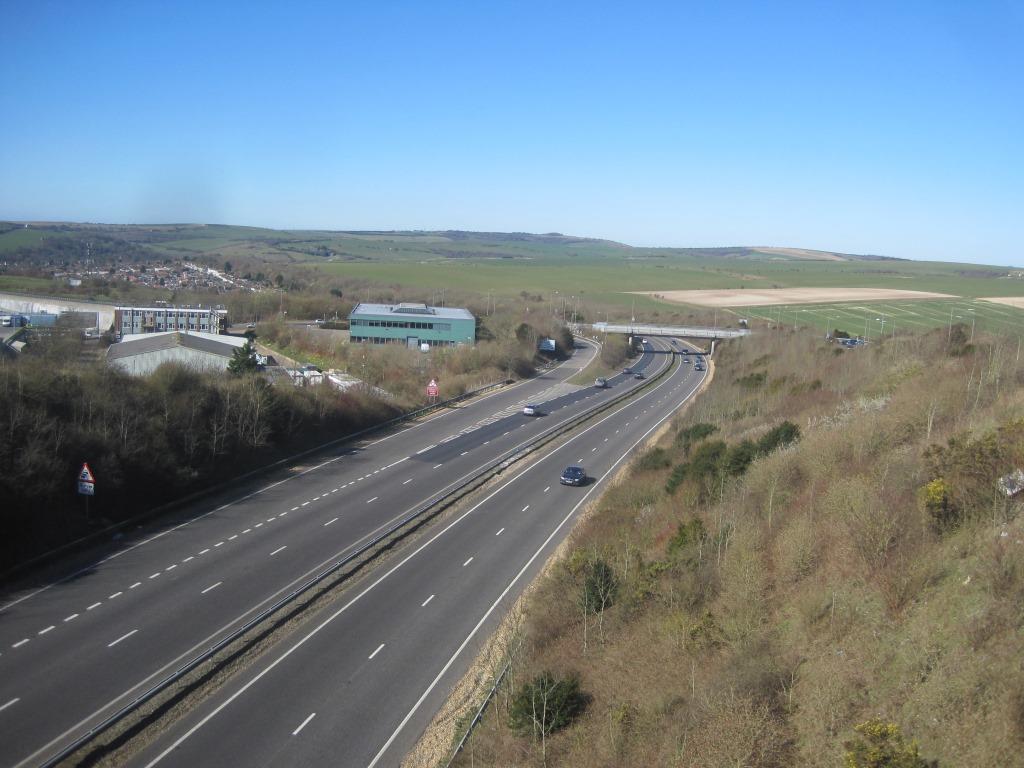
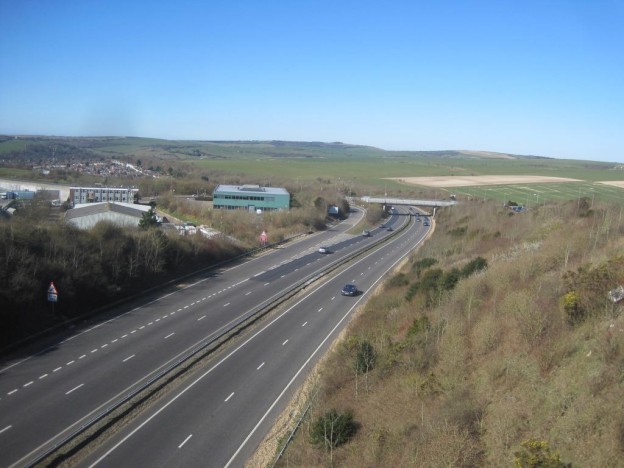
A27 at Hollingbury

Lack of transport vision could blight National Park

On Tuesday, the South Downs National Park Authority discussed its position statement on new transport infrastructure.  This has been drawn up in response to the potential expansion of the A27 but broadened out to include rail, ports and airports.

At the start of the meeting members were reminded that they were there to uphold National Park purposes, not any other interests that they might represent outside of the room.  They were then addressed by Dr Tony Whitbread, chief executive of Sussex Wildlife Trust, Chris Todd from Brighton & Hove Friends of the Earth and Campaign for Better Transport and by Kay Wagland, local Arundel resident and founder of Arundel SCATE.

A27 at Hollingbury

A27 at Hollingbury

All expressed their concern that expanding the A27 would have a large impact on the National Park.  This would not be localised to where changes were made but spread along the whole length of the South Downs and potentially lead to other expensive and damaging interventions.  Indeed, a key concern was that rather than solving congestion, an expanded A27 would create more traffic and ultimately more congestion, albeit in slightly different places.

The debate was interesting and highlighted that several members were struggling to leave their other responsibilities at the door.  However, the vast majority were sincere in their approach, even if they did occasionally say some rather contradictory things.

The Authority eventually agreed a much amended but largely improved position paper, although it did contain a few anomalies and leading statements – for example it specifically mentions the A27 and roads when it is meant to be a position statement for transport infrastructure.  The final statement while a useful and competent outline of the Authority’s position and the South Downs’ special qualities, is a rather dry document.  It contains no vision, nor does it really come across as championing the South Downs landscapes in a way that it could and perhaps should have done.  It also contained one serious omission in that it failed to mention, let alone address, the cumulative impact of expanding several sections of the A27.  This is a serious omission and weakness which is hampered by not having a strategic vision.

While an amendment to insert a vision into the document narrowly failed, members agreed that it would be good to take more time to develop one and that perhaps this could be developed through the Local Plan process.  We shall have to wait and see whether the Authority delivers on this, but in the meantime it will be interesting to see whether this new position statement will have any impact on the current A27 study process.

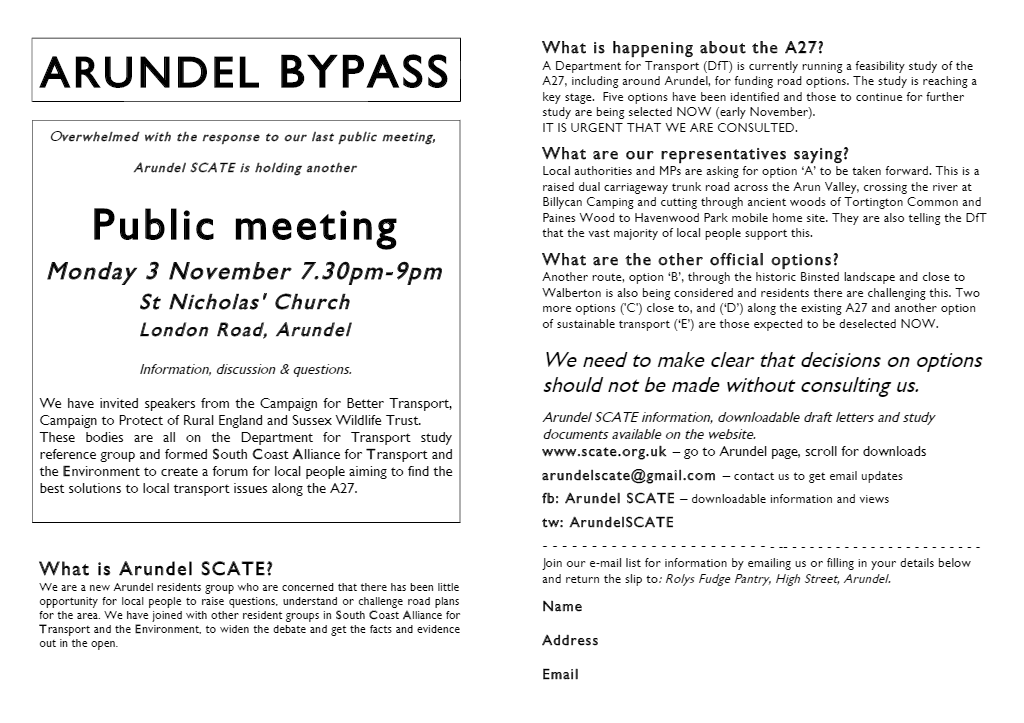
Second public meeting for Arundel

Due to the fact that so many people were unable to get into the meeting to discuss the A27 held at Arundel Town Hall at the end of September, a second public meeting has been organised next week by Arundel SCATE.

This time the meeting is being held at a larger venue: St Nicholas’ Church, London Road, Arundel, from 7.30 – 9pm, on Monday 3 November, so hopefully everyone will be able to get in.

While there was much concern raised at the first meeting at the impact of any offline bypass for Arundel, a key concern now is to make sure that the Department for Transport doesn’t narrow the options ahead of any full and proper public debate.  So come along and find out what is being proposed and what the implications for Arundel might be.

Second Public Meeting Flier


Groundswell of concern in Arundel

Reading the local press or the output from local politicians and you would have thought that everyone in Arundel wants a second A27 bypass.  Well after the last couple of days, that myth has been well and truly exploded.  It is now clear that a significant number of people don’t support that option.

Not only that, but people want access to the facts and to be involved in the debate, rather than be told by politicians or the Department for Transport what’s good for them.  Few, if any, question the need for some form of road improvements, but they want the opportunity to shape what happens to their local community and to arrive at solutions that won’t cost the earth and that most people can support.

All of this started with a few local residents getting together to question whether people in Arundel really wanted a second bypass, particularly a highly damaging offline bypass.  They were concerned that many people did not know about the proposals and that there had been very little discussion within the town about them.

Walk along River Arun to see proposed river crossing

Walk along River Arun to see proposed river crossing

To address this they organised a fact-finding walk on Sunday, open to all residents, close to the preferred route of many local politicians, including Nick Herbert MP.  This route goes through Tortington Common and other ancient woodland and as Tony Whitbread, Chief Executive of Sussex Wildlife Trust said, if it went ahead would represent one of the biggest losses of ancient woodland in Sussex in recent years.  It follows the line of the previously proposed ‘pink/blue’ route and is option A in the current process.

Contrary to all expectations, nearly 100 people (mostly local) turned out to walk around the area.  They saw the work of local landowners in Tortington Common managing the woodland and heard about the wildlife living there and saw what potentially what could be lost with a second offline bypass.

Tony Whitbread addressing walkers in ancient woodland on Tortington Common

Tony Whitbread addressing walkers in ancient woodland on Tortington Common

Then yesterday, a public meeting, open to all, was organised to allow local people to find out more about what was being proposed.  However, the organisers, Arundel SCATE, didn’t bank on so many people wanting to get involved.  Arundel Town Hall which has a fire capacity of nearly 100 upstairs was quickly full and nearly 200 people had to be excluded downstairs and outside.

Inside the meeting, there was a range of discussion including some pro-bypass viewpoints, but the overwhelming feeling of the meeting was against a second offline bypass because of the damage it would wreak whichever line it took.  Surprisingly, the vast majority wanted online or near online improvements focussed on tackling the blockages, such as at Crossbush or the traffic lights near the station, along with other improvements to reduce the severance the A27 currently causes.  This is surprising because of the stance taken by local politicians keen to rule out online improvements and who have been pushing strongly for a second offline bypass.

Given this wake-up call, where once again politicians have been shown to be out of touch with local people, poiticians now need to make sure that the options going forward for consideration, include the options that local people want to see progressed.  At present there is a danger that these have already been ruled out by the powers that be.  That, for so many reasons, would be wrong and needs to be addressed before it is too late.

There’s never been a traffic jam on the M25!

Tony Whitbread, Chief Executive of Sussex Wildlife Trust, writes about the failure of roadbuilding as a solution to traffic congestion.

M25

M25 traffic jam. Photo: Ken Douglas (https://www.flickr.com/photos/good_day/47214886/)

One of the most worrying features of the current rush for road building is the severe lack of strategic thinking in the proponents.

The solutions put forward are surrounded by the appropriate jargon – “route-based strategies”, “transport infrastructure”, “strategic road network” and so on – but they are all basically knee-jerk reactions. Traffic jams are predicted and a new road is pushed as the answer. Predict and provide in its simplest form.

A bypass here, a dual carriageway there, then it all needs expanding again. Some wish to see the whole south coast with dual carriageways of motorway proportions along its length. Bigger, then bigger again until we have something like the M25 running through Sussex – and after all, as well all know, there has never been a traffic jam on the M25!

Simplistic road building strategies fall apart when you start to consider what then happens. Build a road in one place and the jam just moves to somewhere else – and demands increase for a new road there as well. Traffic then increases elsewhere and again road developments are demanded. Environmental damage is bad in one place, but magnified up by all the increasing demands for new roads and it becomes much worse.

This would be bad enough with a constant level of traffic, but new roads generate new traffic. Even if one location is eased, people will then perceive the slight ease in congestion so will travel more often, so increasing traffic. Those who believe that new roads will reduce congestion are fooling themselves. A few favoured locations may be relieved, but overall the level of traffic throughout Sussex will increase.

Bear in mind also that many are proposing these roads specifically to drive an increase in traffic. Road building is wanted in order to “unlock areas for development” – to enable more of the countryside to be built on. Tarmac over part of Sussex so you can concrete over other parts. Development may be needed, but this has to be carefully designed sustainable development, not just a rush to build roads and houses.

So what are the answers?

First we have to question a few “truths” we are told. Road traffic is not shooting upwards, indeed some think that road traffic has peaked across the developed world. People are finding other ways of gaining access to their needs and a focus back on roads risks bucking an otherwise good trend.
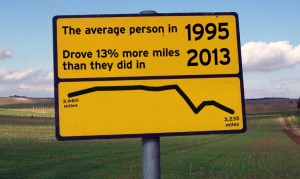
road sign cbt

Image: Campaign for Better Transport (www.bettertransport.org.uk)

Also I’m old enough to remember nearly 20 years ago we were told that if we didn’t get bypasses round Arundel and Worthing then the economy would collapse. 20 years later we have been through a period of strong economic growth. Sussex did not become destitute. We were told cycling would never increase – it did. People wouldn’t use buses – they do. There would never be more people working from home – there are. Teleconferencing is impractical – it isn’t. And so on.

The truth is, as we’ve learned many times before, you can’t build your way out of the problem. Answers have to be sophisticated not simplistic. They may include some minor on-line improvements to roads, but to ease flow not to add capacity. Improvements to public transport will be part of the mix and, as most journeys are short, cycling and walking are perhaps where some large gains could be made. But the key long term solution is to reduce the need to travel – modern technology, developments in communication, management systems improvements and integrated planning to reduce travel.

We live in a small over crowded part of the country.  Imagining that there is always unlimited space to expand roads into is a dream world. Building roads to add to the congestion is no solution.
SCATE submission to Department for Transport on A27

A27_near_Middle_Farm,_Firle_-_geograph.org.uk_-_1031235

A27 near Firle. Picture: Kevin Gordon


SCATE has issued its response to the Department for Transport feasibility study on the A27 proposal. It echoes much of what Campaign for Better Transport said in its own response to the study, which concludes that, ‘…the whole premise of these studies appears to be to enable more roadbuilding regardless of whether that makes sense economically, environmentally or socially.’

SCATE’s submission raises a number of issues which are not addressed by the DfT study.  These include, crucially, the effect of the proposed new roads on greenhouse gas emissions; how much new traffic will be generated by expanding the A27; how the proposals will affect public transport measures; and what is being done to assess possible improvements in public transport as a means of ameliorating congestion?  For a full list of questions, see here.

Alternative proposals
In its submission, SCATE comes up with a number of possible solutions to the issue of congestion on the A27.  These include junction improvements, bus links, school and work travel plans and improving cycling and walking infrastructure.  Particular attention is paid to the area around Arundel, the damage that a new bypass would cause (including to a large block of ancient woodland), and alternatives that could reduce congestion on the existing bypass.

750px-A_good_cycle_path_in_Ipswich

More investment in cycling needed. Picture: Peter Ito


Public transport: better in 1954

The submission points out that a major source of congestion on the A27 north of Eastbourne comes from people driving from the north, including from Hailsham and Uckfield, via the A22. In 1954, the train journey from Hailsham to Eastbourne took 16 minutes, making it an easy commute.  Sixty years later, the journey by public transport (by bus: there is no longer a train station at Hailsham) takes around 40 minutes.  There are many other opportunities outlined in the submission for improvements in public transport which could make a real difference to congestion, as well as reducing carbon emissions and avoiding the huge destruction that would be caused by ‘improvement’ of the A27.

No need for substantial interventions

In conclusion, SCATE says, ‘From the evidence submitted so far, SCATE cannot see the need for any substantial interventions with the A27 in the form of major new road construction. The great majority of the traffic on all the sections of the A27 under study is local, with very little long-distance traffic for which trunk roads are normally provided. Most of the pressure on the road is during peak hours, when people are travelling to and from work or ferrying children to and from school. Outside these hours and at weekends, traffic generally flows freely.’


A27 Action Campaign suffers first setback

The A27 Action Campaign suffered its first setback yesterday when Brighton & Hove City Council voted against a Conservative motion asking the Council to support the dualling of the A27 along its entire length.  Both Greens and Labour voted against the motion and were not taken in by some of the spurious arguments being made for the road.

These appeared to be following Nick Herbert MP’s line of how it would bring huge environmental benefits to the National Park while failing to point out that it would cost £2 billion to get around Worthing in a tunnel, so how likely would it be to happen anyway?  Either that or it goes through the town which would be extremely unpopular too.

It is often overlooked that if the road was dualled along its whole length it would attract more traffic to use it.  This would come from  the surrounding roads to an extent, from people who currently use public transport but get back into a car ,and from longer distance traffic switching down to the south coast to avoid the M3 / A3 and M25.  The induced traffic would bring no benefit to the economy, would increase congestion and undermine public transport.  All would increase noise pollution and traffic in the National Park, even if a few routes benefited.  Therefore all you would achieve would be to move the congestion around.

It certainly would increase congestion in Brighton and other coastal towns as the traffic on the A27 mostly starts and finishes in these places.  Faster moving traffic on dual carriageways would also dramatically increase noise pollution, harming tranquility in the National Park.  That’s before you consider any landscape and wildlife impacts.

So well done Brighton & Hove City Council for not jumping on the A27 bandwagon.  It has shown that investing in public transport and other sustainable measures supports the local economy.  Its neighbours need to start understanding that too.